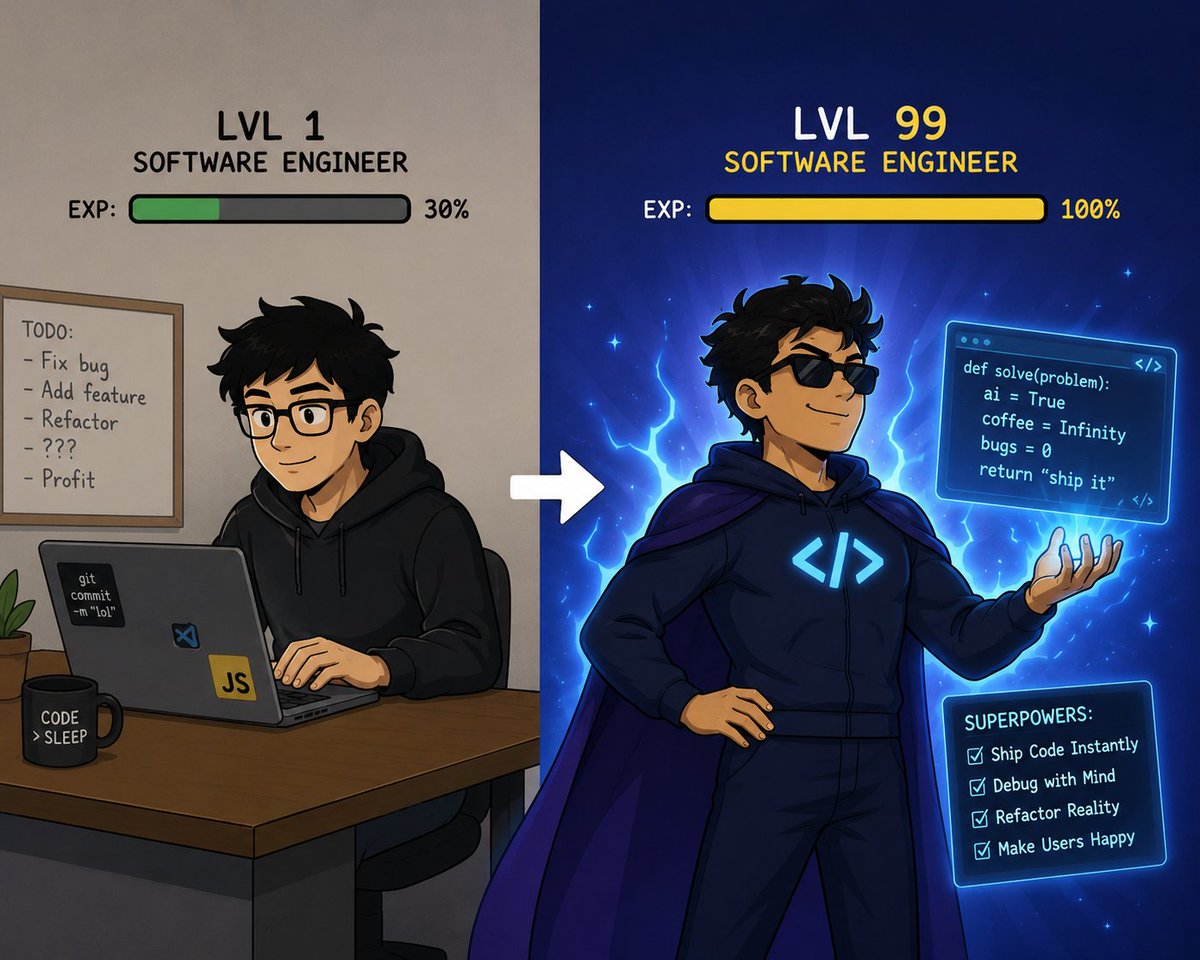
Here's something nobody really prepares you for. You spend years assuming age is the thing standing between you and being taken seriously. And then one day you're in the room, you're trusted, you're shipping, you're making real calls, and you realize the wall you built up in your head was mostly just that. In your head.
I turned 21 recently. And instead of feeling like some big milestone, it mostly just made me look back at the last two years and think about how different the reality was from what I expected.
I've been on the other side of the hiring table. Led a team. Shipped product that real people actually use. Been in rooms where the decisions mattered and I was one of the people making them. And through all of it, my age came up exactly zero times.
That's the thing that keeps sticking with me.
Because when you're young and trying to break in, you convince yourself that everyone inside has something you don't. Some kind of earned credibility that only comes with time and there's no way around it. You just have to wait your turn. Very dramatic. Very LinkedIn-core. Unfortunately, I fully believed it lol.
What I actually found is that nobody was checking. They just wanted to know if you could do the work. And that's a very different bar than the one I thought I was up against.
The age gap didn't disappear though. I want to be clear about that. It just moved. And I think it's worth being honest about where it actually lives now, because I don't see a lot of people talking about that part.
The Experience Curve Used to Mean Something
Not long ago, being senior at something actually meant something specific. It meant you had seen things break in ways that surprised you. You had made the wrong call on something important and lived with the consequences. You had pattern recognition that only comes from repetition, from shipping things that failed, from sitting in enough postmortems that you start to see failure coming before it arrives.
That was the moat. Time. Not intelligence, not raw skill, just all the situations you had been through. A 30 year old engineer wasn't necessarily smarter than a 22 year old. They just had a decade of edge cases living in their head that the 22 year old hadn't encountered yet.
And that gap was real. It showed up in the quality of decisions. In how someone handled ambiguity. In whether they panicked when things went sideways or just quietly started fixing it. You couldn't fake that kind of depth because it came from somewhere specific. It came from time.
Here's what changed though. That pattern recognition, the thing that used to take a decade to build, is now something you can access on day one. Not perfectly, not in every context, but enough to close the gap in ways that genuinely weren't possible before. The tools exist now to compress that learning cycle dramatically. You can run more experiments faster, get feedback sooner, understand failure modes earlier, and iterate at a speed that used to be physically impossible for one person or a small team.
The experience curve didn't disappear. But the slope changed. What used to take six years can now be compressed into a month if you're in the right environment and actually paying attention. That last part matters because some people are "using AI" and some people are just outsourcing their thinking with extra steps.
That's not a small shift. That's a fundamental change in what it means to be "experienced" and who gets to be considered that way.
What AI Actually Changed
I want to be specific here because I think the generic "AI makes you more productive" take is mostly useless. Everyone says it. Nobody really explains what it actually changes at the level that matters.
Here's what I've noticed from actually being inside it.
The thing AI changes most isn't output speed, though that's real too. It's the ceiling on what one person can credibly take on. Before, there was a natural limit to how much domain you could own at once. You could be great at one layer of the stack. You could go deep on one problem space. Spreading too thin meant becoming shallow, and shallow got exposed fast when things got hard.
Now that ceiling is higher. Not infinitely higher, but meaningfully higher. I can go deep on voice AI architecture, context window management, latency tradeoffs, and evaluation frameworks simultaneously in a way that would have required a small team or years of accumulated specialization before. I'm not saying I'm the world's leading expert in all of those things. I'm saying I can operate credibly across them, ask the right questions, make reasonable calls, and know when I'm out of my depth. That's a completely different thing from what was possible even two or three years ago.
The second thing AI changed is the feedback loop. You used to learn by doing something, watching it fail, waiting for someone more experienced to tell you what went wrong, and then trying again. That cycle was slow by design. Now you can compress it. You can simulate failure modes before you hit them, stress test your own reasoning, and get a second opinion on a decision in thirty seconds. The learning still happens inside your head. But the inputs come faster and from more directions than ever before.
What this means practically is that a 21 year old who is obsessed, who is paying attention, who is actually using these tools intentionally rather than just prompting their way through tasks, can build genuine depth at a rate that simply wasn't available to someone at the same stage five years ago. The gap between them and a senior person with ten years of experience is still real. But it's closing faster than most people want to admit.
This is closer to how I think about it. The point isn't that software developers disappear. The point is that the ones who actually know how to use the tools start looking kind of unfair. If your taste is bad, AI just helps you make bad decisions faster (which is impressive in the worst possible way). But if your judgment is good, it turns into a multiplier.
Being the Youngest in the Room
For a long time I thought being the youngest in the room was the thing I had to overcome. Like it was a handicap I was carrying and my job was to make people forget about it as fast as possible.
What I actually found is that nobody was thinking about it as much as I was.
The people in those rooms are not sitting there doing age math on you. They're thinking about the problem in front of them. They're thinking about what needs to get done and whether you're the person who can help get it done. That's the whole calculation. And once I internalized that, something shifted. I stopped walking into rooms trying to seem older or more experienced than I was, and started just focusing on being useful. On knowing my stuff. On having a real opinion and being able to back it up.
The imposter syndrome doesn't fully go away though. I'd be lying if I said it did. You still feel the gap sometimes, especially around people who have built companies, raised multiple rounds, or seen entire market cycles. But I think that pressure is only a problem when it turns into hesitation.
When it pushes you to prepare more, ask better questions, and keep improving, it's useful. When it makes you shrink in rooms where you actually have something to contribute, it's not. I've tried to treat it as a signal to get sharper, not as proof that I shouldn't be there.
The other thing I noticed is that being young in the room comes with one advantage nobody really talks about. You have less to protect. Older, more established people sometimes hold back an opinion because they have a reputation to manage, relationships to preserve, a position to maintain. I didn't have any of that. I could just say what I actually thought. And sometimes that directness, coming from someone who clearly had no political agenda, landed differently than it would have from someone with more seniority. Not always. But enough times that I noticed it.
The youngest person in the room isn't a liability by default. It's just a starting condition. What you do with it is the part that actually matters.
TLDR
Age matters less than it used to. The real gap now is whether you understand the systems deeply enough to make good calls when the tools make everyone faster. AI compresses the learning curve, but it doesn't replace taste, judgment, or actually caring enough to go deep. If you're an intern, or you're 19, 20, 21, take the leap. Don't assume you know less just because you've been around for less time. Knowledge doesn't automatically come with time. It comes from paying attention, taking ownership, and putting yourself in rooms where the work actually matters.